As energy costs continue to rise, more homeowners and business owners are searching for long-term solutions that reduce electricity expenses and improve energy efficiency. One of the most effective solutions available today is solar energy. Solar panels have quickly become one of the smartest investments for both residential and commercial properties, offering long-term savings while supporting sustainable energy production.
However, many property owners who have flat roofs often ask an important question:
Can solar panels be installed on a flat roof?
The answer is yes — absolutely.
In fact, flat roofs can often provide excellent opportunities for solar installations when the system is properly designed and installed by experienced professionals. Unlike sloped roofs, flat roofs allow installers to carefully control the direction and tilt of the panels, which can actually improve solar energy performance.
That said, installing solar panels on a flat roof requires thoughtful planning. The panels cannot simply be placed flat on the surface. Instead, they must be mounted at the proper angle, securely anchored, and installed in a way that protects the roofing system from damage or leaks.
We have helped many homeowners, property managers, and building owners evaluate solar panel installations on a wide variety of roofing systems. Each project requires a detailed understanding of both roofing structure and solar system performance.
In this guide, we will explain:
-
How solar panels work on flat roofs
-
The advantages of flat roof solar installations
-
Common installation methods used by professionals
-
Important structural and roofing considerations
-
Maintenance tips to protect both the roof and solar system
-
Cost and return on investment expectations
By understanding these factors, property owners can make confident decisions and ensure their solar installation remains safe, efficient, and long-lasting.
Why Solar Energy Is Becoming Essential for Modern Buildings
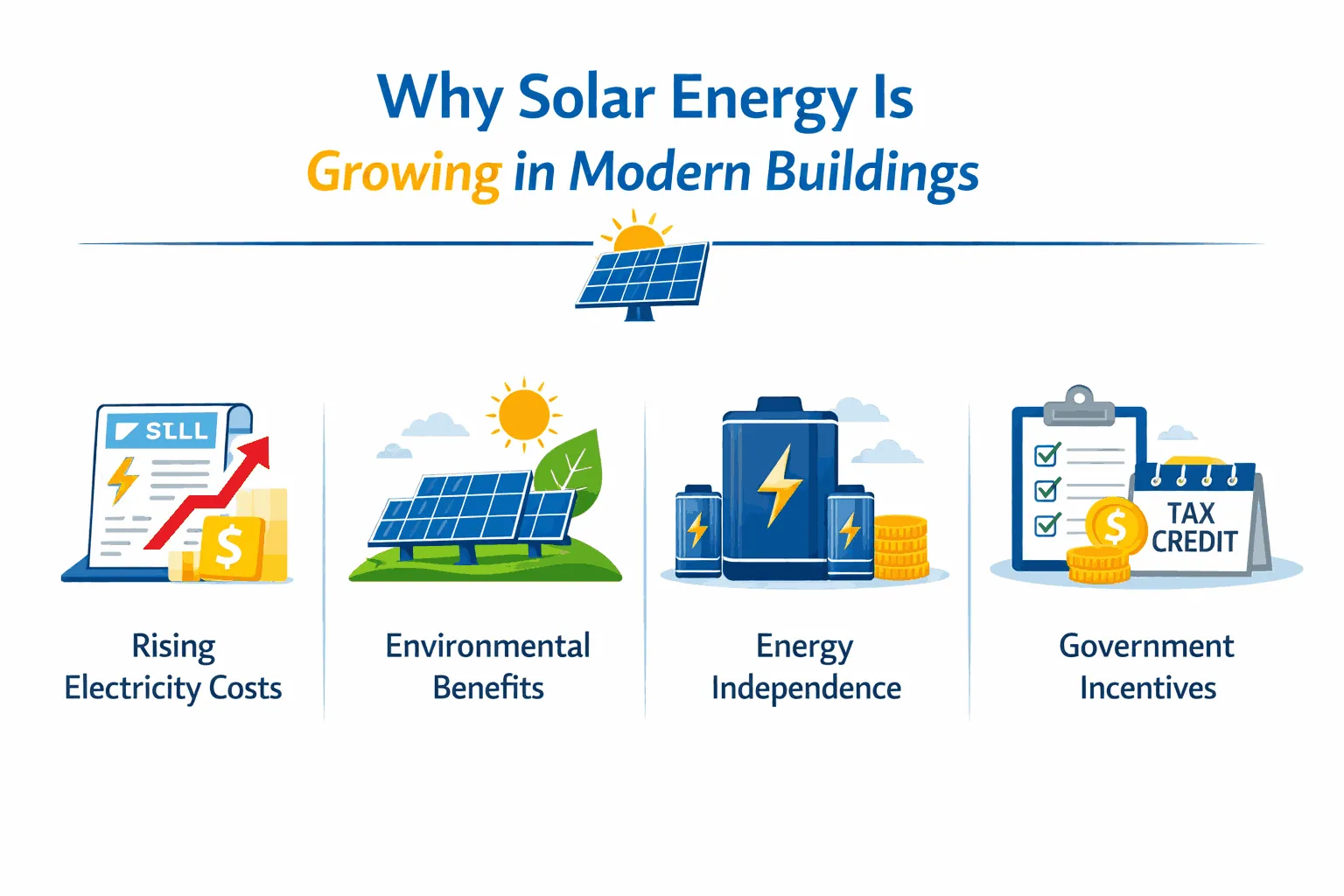
Solar energy adoption has increased significantly over the past decade. Several factors have contributed to this shift.
Rising Electricity Costs
Electricity prices continue to increase in many regions, placing a financial burden on both households and businesses. Solar panels allow property owners to generate their own electricity, significantly reducing dependence on traditional utility providers.
Environmental Responsibility
Solar power produces clean, renewable energy without harmful emissions. Many homeowners and organizations are choosing solar energy to reduce their environmental footprint and contribute to sustainability efforts.
Energy Independence
Solar installations allow buildings to become less dependent on the grid. With battery storage systems, some properties can even store excess energy for use during outages or peak demand periods.
Government Incentives
Many governments offer tax credits, rebates, and incentives for solar installations. These financial programs help offset installation costs and accelerate the return on investment.
Because of these advantages, solar installations are no longer considered luxury upgrades — they are becoming a smart long-term energy strategy for modern properties.
Are Flat Roofs Suitable for Solar Panels?
Many people assume that sloped roofs are the best option for solar panels, but this assumption is not always accurate.
Flat roofs can actually offer several distinct advantages when it comes to solar installation design and performance.
Unlike sloped roofs, which already have a fixed angle and direction, flat roofs provide installers with a blank canvas. This flexibility allows solar panels to be positioned in the most efficient direction to capture sunlight.
However, proper design and engineering are essential. Solar panels should never be mounted completely flat against the roof surface. Doing so would reduce energy production and increase the risk of debris buildup or water pooling.
Instead, professional installers use tilted racking systems that elevate the panels and orient them toward the sun.
When installed correctly, flat roof solar systems can perform just as well — or even better — than systems installed on sloped roofs.
Key Benefits of Installing Solar Panels on a Flat Roof
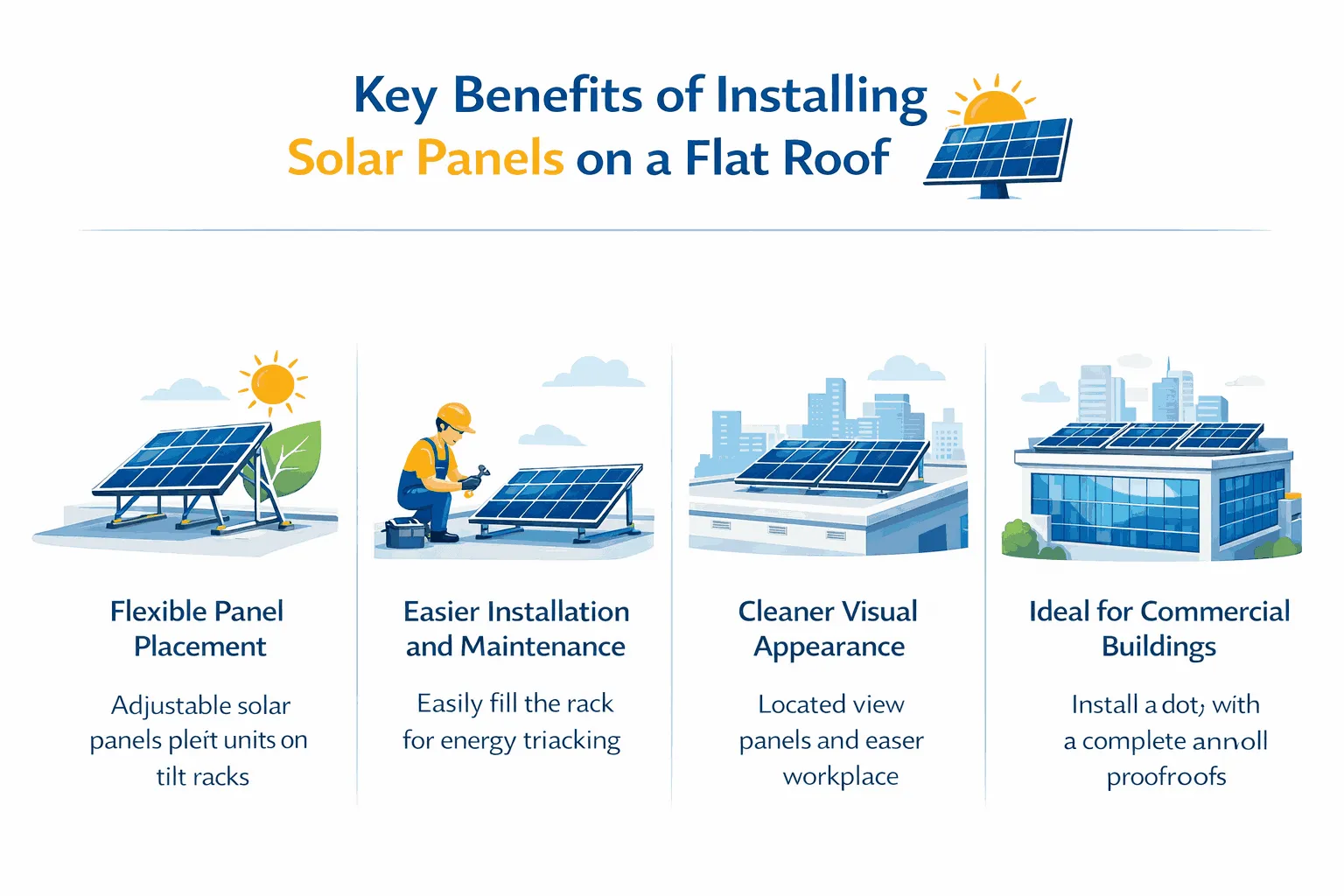
Flat roofs provide several advantages that make them highly suitable for solar installations.
Flexible Panel Placement and Orientation
One of the biggest advantages of flat roofs is complete control over panel orientation.
On sloped roofs, panels must follow the roof’s natural angle and direction. If the roof faces the wrong direction, energy production may be reduced.
Flat roofs eliminate this limitation. Installers can use adjustable racking systems to tilt the panels toward the optimal direction for sunlight exposure.
This flexibility allows solar systems to:
-
Maximize solar energy production
-
Capture sunlight more consistently throughout the day
-
Improve overall system efficiency
Because of this adaptability, flat roofs can sometimes produce more energy than poorly oriented sloped roofs.
Easier Installation and Maintenance
Flat roofs create safer and more accessible workspaces for installation teams.
Technicians can move around the roof safely without dealing with steep slopes or dangerous angles. This makes the installation process more efficient and reduces potential safety risks.
Maintenance is also easier. Technicians can easily access panels to:
-
Clean dust and debris
-
Inspect wiring and mounting systems
-
Perform system upgrades
-
Replace damaged components
On steep roofs, these tasks often require specialized equipment and safety harnesses.
Flat roofs make long-term maintenance simpler and safer.
Cleaner Visual Appearance
Solar panels installed on sloped roofs are often highly visible from the street. Some homeowners worry that this may affect the appearance of their property.
Flat roof installations are typically less visible, especially when panels are positioned toward the center of the roof.
This creates a cleaner visual appearance while still allowing the property to benefit from solar energy.
This advantage is particularly important in areas with:
-
strict design guidelines
-
historic building requirements
-
homeowner association rules
Flat roof solar installations allow buildings to maintain their exterior aesthetics.
Ideal for Commercial Buildings
Many commercial properties already have large flat roofs, making them ideal for solar installations.
Warehouses, office buildings, retail centers, and industrial facilities often have expansive rooftop areas that receive consistent sunlight.
These large roof spaces allow businesses to install larger solar systems, significantly reducing electricity expenses.
For many companies, solar installations can provide long-term energy savings while improving sustainability efforts.
How Solar Panels Are Installed on Flat Roofs
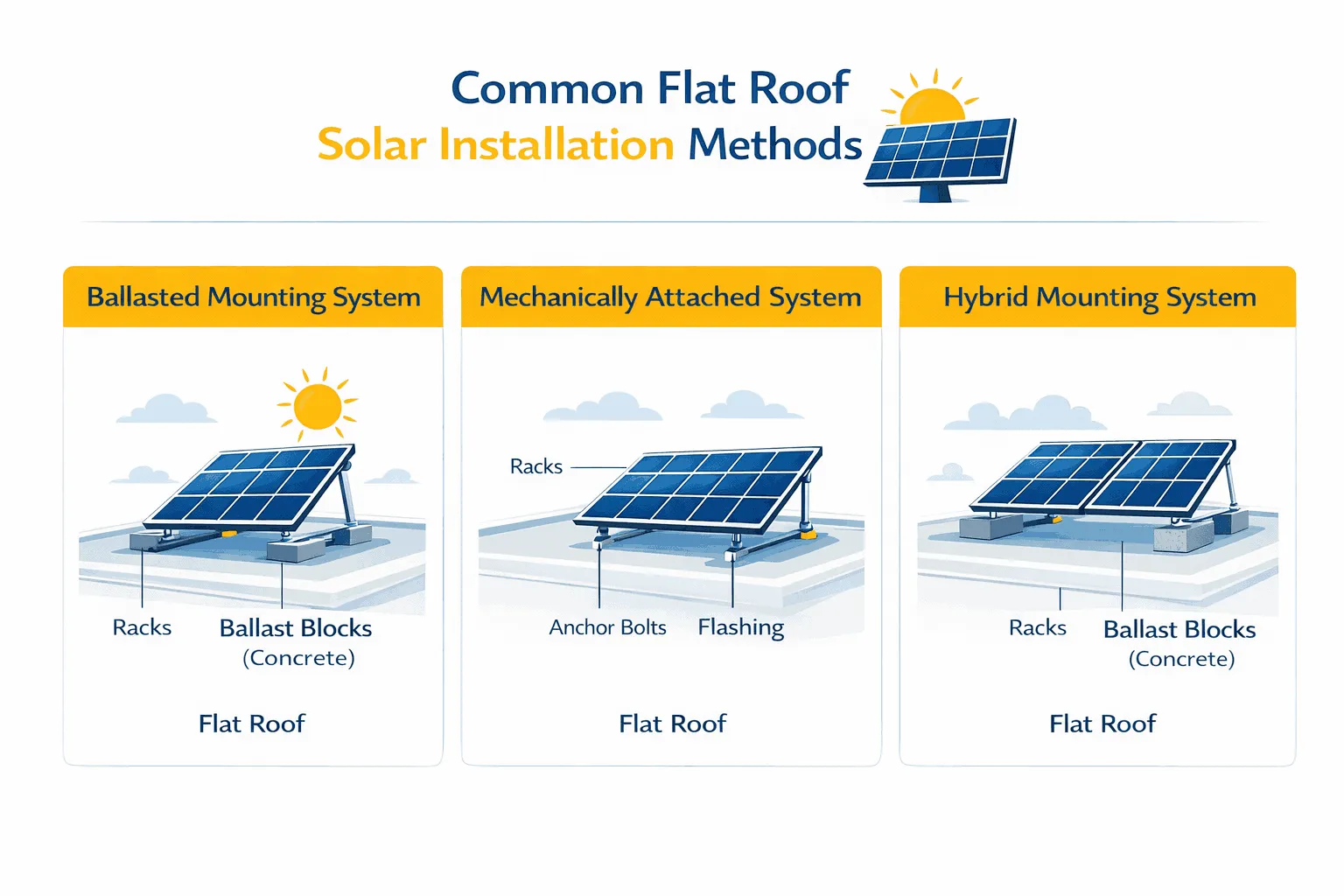
Solar panels must be mounted properly to ensure both safety and performance. The installation method depends on several factors including roof structure, wind exposure, and weight capacity.
The three most common flat roof mounting systems are:
Ballasted Mounting Systems
Ballasted systems are one of the most widely used installation methods for flat roofs.
Instead of drilling into the roof structure, solar panels are mounted onto a metal racking system that is secured with weighted ballast blocks, usually made from concrete.
These weights hold the panels firmly in place while avoiding roof penetrations.
Advantages of Ballasted Systems
-
No drilling into the roof membrane
-
Reduced risk of water leaks
-
Faster installation
-
Easier system removal or adjustment
Ballasted systems are commonly used for commercial buildings and residential flat roofs with strong structural support.
Mechanically Attached Mounting Systems
In mechanically attached systems, the racking structure is fastened directly to the building structure using bolts and flashing systems.
These penetrations are carefully sealed to maintain roof waterproofing.
Advantages of Attached Systems
-
Lower overall weight compared to ballasted systems
-
Stronger resistance to high winds
-
Suitable for roofs with lower weight capacity
These systems are often recommended in areas with strong wind conditions.
Hybrid Mounting Systems
Hybrid systems combine features of both ballasted and mechanically attached installations.
Some racks are weighted, while others are secured directly to the roof structure.
This approach helps balance:
-
wind resistance
-
structural load
-
installation stability
Hybrid solutions are often customized based on the specific characteristics of the building.
Important Considerations Before Installing Solar Panels on a Flat Roof
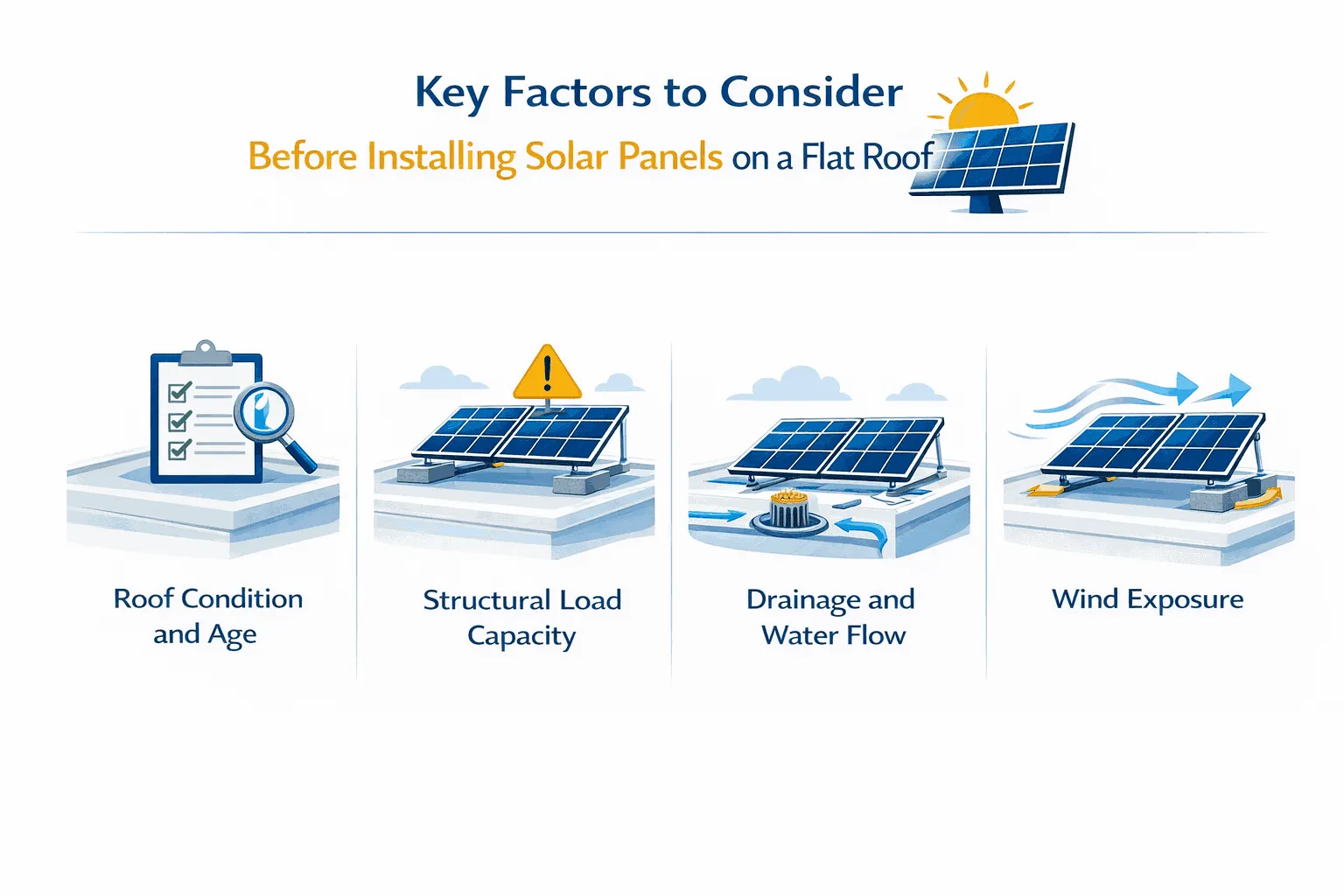
Installing solar panels involves much more than simply placing panels on the roof. Several structural and design factors must be evaluated before installation.
Roof Condition and Age
Before installing solar panels, it is essential to inspect the condition of the existing roof.
Flat roofs commonly use materials such as:
-
EPDM rubber roofing
-
TPO membranes
-
PVC roofing
-
Modified bitumen
If the roof is nearing the end of its lifespan or shows signs of damage, it may be best to repair or replace it before installing solar panels.
Removing solar panels later for roof repairs can be expensive and time-consuming.
A roof inspection ensures the structure will support the solar system for many years.
Structural Strength and Load Capacity
Solar panels, racking systems, and ballast blocks add extra weight to the roof.
Structural engineers must verify that the building can safely support this additional load.
Flat roofs usually distribute weight evenly, but older buildings or weakened roof decking may require reinforcement.
A professional evaluation ensures that the solar system will remain stable without damaging the building.
Drainage and Water Flow
Flat roofs are designed with slight slopes to guide water toward drains.
Solar panel systems must be installed in a way that does not block drainage paths.
Poor planning can create water pooling issues, which may accelerate roof deterioration.
Professional installers carefully position panels to allow water to flow freely toward drains and scuppers.
Wind Resistance and Weather Exposure
Because flat roofs are exposed to open air, solar panels may experience stronger wind uplift compared to sloped roofs.
Proper mounting systems and aerodynamic design help prevent wind damage.
Engineers evaluate local wind conditions to determine the safest mounting method and tilt angle.
Maintenance Tips for Flat Roof Solar Systems
Solar systems require minimal maintenance, but regular inspections help maintain peak performance.
Keep Panels Clean
Dust, pollen, leaves, and bird droppings can reduce solar panel efficiency.
Cleaning panels periodically ensures maximum sunlight absorption.
Inspect Mounting Systems
After severe weather events, it is wise to inspect mounting hardware and ballast blocks to ensure they remain secure.
Monitor Energy Production
Most solar systems include monitoring software that tracks energy output.
If production drops unexpectedly, it may indicate shading issues or electrical problems.
Conduct Annual Roof Inspections
A yearly roof inspection ensures that both the roofing system and solar installation remain in good condition.
Cost and Return on Investment
The cost of a flat roof solar system depends on several factors, including:
-
system size
-
mounting method
-
roof condition
-
installation complexity
-
available incentives
Although installation requires an upfront investment, solar panels typically provide significant long-term savings.
Most property owners recover their investment through:
-
lower utility bills
-
government tax credits
-
increased property value
Flat roof systems often produce strong returns because installers can position panels at the most efficient angle for sunlight exposure.
Why Roofing Expertise Matters for Solar Installation
Many solar installers focus primarily on electrical performance. However, roofing considerations are equally important.
Improper installation can damage roofing membranes, create leaks, or shorten the lifespan of the roof.
Working with an experienced roofing contractor ensures that solar panels are installed in a way that protects the building.
At MK Best Roofing, we specialize in evaluating roofs for solar readiness. Our team can inspect your roof, repair any issues, and ensure that your solar installation integrates safely with your roofing system.
Conclusion
Installing solar panels on a flat roof is not only possible — it can be one of the most effective ways to generate renewable energy for your property.
Flat roofs offer flexibility, efficient panel positioning, easier maintenance, and large installation space. When the system is properly designed and installed by experienced professionals, flat roof solar installations can provide decades of reliable energy production.
However, careful planning is essential. Property owners must evaluate roof condition, structural strength, drainage, and wind exposure before moving forward with installation.
By working with qualified roofing and solar professionals, homeowners and business owners can ensure their solar investment remains safe, efficient, and long-lasting.
If you are considering installing solar panels on your flat roof, the first step is a professional roof inspection.