Most flat roofs don’t fail because the membrane wore out. They fail because a drain stayed clogged for two seasons, an HVAC tech dragged a toolbox across the field, or a hairline split at a pipe boot went unnoticed until the ceiling stained. Nearly every one of those failures is cheap to prevent and expensive to fix. This guide covers what actually goes wrong on low-slope roofs, how to inspect yours without damaging it, and why the maintenance rules change depending on which membrane you have. The advice for EPDM rubber is not the advice for TPO, and using the wrong product on either one can end your warranty in an afternoon.
What Are the Flat Roof Maintenance Rules That Actually Matter?
- Inspect twice a year, late spring and mid-fall, plus after hail, high wind, or any rooftop service call.
- Nothing should still be standing 48 hours after rain. That is the industry threshold for ponding, not a cosmetic preference.
- Clear drains, strainers and scuppers at least twice a year, quarterly if you have trees, and confirm the overflow path works rather than just the primary drain.
- Identify your membrane before buying any sealant or coating. Asphalt-based products damage EPDM. Acrylic coatings fail under ponding.
- Keep a written roof file. Manufacturer warranties typically expect documented maintenance, and a claim with no records behind it is a weak claim.
How Flat Is a Flat Roof, Really?
A flat roof is more accurately a low-slope roof. In US practice the dividing line is usually drawn at 2:12. Below roughly 2 inches of rise per 12 inches of run, a roof stops shedding water and needs a waterproof membrane instead of shingles. You will also see 3:12 used as the steep-slope boundary in some industry references, so don’t be thrown if the number moves depending on who wrote the page.
The International Building Code sets the minimum design slope for membrane roof coverings at one-quarter unit vertical in 12 units horizontal, a 2 percent pitch. Coal-tar built-up roofs get an exception at one-eighth in 12. A quarter inch of fall over a foot works out to about 1.2 degrees. That number is the entire reason flat roof maintenance is its own discipline. There is almost no gravity assist. Water leaves your roof because the drainage design works, or it doesn’t leave at all.
Slope also gets worse over time. Decks deflect under load, insulation compresses under foot traffic, and a roof that drained cleanly in year one can hold an inch of water by year twelve. Which is why you inspect rather than assume.
How Do You Identify Your Flat Roof Membrane?
Ask ten homeowners what their flat roof is made of and most will say “rubber.” Only EPDM actually is. Each of these systems has a different weak point, a different repair method, and its own list of products that will ruin it. Start here before you do anything else.
| System | How to recognize it | Commonly cited service life | First thing that fails | Never use on it |
|---|---|---|---|---|
| EPDM (rubber) | Matte black (sometimes white) sheet, wide rolls, seams taped or glued | 20 to 30 years | Seams and flashing adhesive, especially at cold-installed laps | Petroleum solvents, asphalt cement, roofing tar |
| TPO | Bright white (or gray/tan) sheet with a slight sheen, heat-welded seams | 20 to 30 years | Weak or skipped heat welds at corners and drains; surface crazing on older stock | Solvent-based cleaners, incompatible sealants, asphalt |
| PVC | White welded sheet, softer feel than TPO, common over commercial kitchens | 20 to 30 years | Plasticizer loss late in life; the membrane stiffens and gets brittle under impact | Contact with asphalt or EPDM products |
| Modified bitumen | Rolled asphalt sheet, often granule-surfaced, torched or self-adhered | 15 to 25 years | Granule loss, seam lifting at laps, blistering | Silicone over an unprimed, oily surface |
| Built-up (BUR) | Layered felt and bitumen under gravel or a cap sheet | 20 to 30 years | Alligatoring, gravel displacement, flashing splits | Pressure washing, which strips the surfacing |
| Spray foam (SPF) | Seamless, slightly textured, always coated | Long, but entirely dependent on recoating on schedule | Coating erosion, bird pecking, hail bruising | Leaving it uncoated, since UV destroys exposed foam quickly |
Treat those service lives as rough planning figures rather than promises. Published ranges vary widely between sources because membrane thickness, attachment method, climate, foot traffic and maintenance history all move the number, sometimes by a decade in either direction. Your own warranty term and the current condition of your roof are far better guides than any general range.
If you can’t tell what you have, photograph a seam and a drain edge and send them to a local roofer. Ten minutes of identification prevents the most expensive mistake in flat roof care, which is applying the wrong product.
How Long Should Water Sit on a Flat Roof?
The National Roofing Contractors Association’s criterion is that there should be no ponding water on the roof 48 hours after a rain, under conditions conducive to drying. Anything shorter is normal and largely unavoidable. Anything longer is a defect, and manufacturer warranties commonly treat it as one.
Why standing water is worse than it looks
- Weight. Water weighs about 62.4 lb per cubic foot, which is roughly 5.2 lb per square foot for every inch of depth. A 20 ft by 20 ft pond just 1.5 inches deep adds around 3,100 lb to the deck. As the deck deflects, the pond deepens and gets heavier still. Engineers call this ponding instability, and the building code requires susceptible roof bays to be evaluated for it.
- Accelerated aging. Constant immersion softens adhesives and works at seams, in exactly the spots you can’t see from above.
- Biological growth. Algae and moss take hold in ponded areas, hold more moisture, and shed debris that clogs drains downstream.
- Slip risk. A wet single-ply membrane is genuinely slippery, and ponded areas give you the worst footing on the roof.
- Warranty exposure. Ponding is commonly excluded or limited in both membrane and coating warranties.
A field test worth doing: after the next steady rain, wait two full days of dry weather, then mark the outline of any remaining water with chalk or tape and photograph it. Repeat after the next storm. If the same outline comes back in the same place, you have a slope or deck problem rather than a cleaning problem. The fix is tapered insulation, a cricket, or an added drain. It is not more sealant.
Where Do Flat Roofs Actually Leak?
The open field of the membrane is the strongest part of the roof. Leaks concentrate almost entirely at the interruptions:
- Penetrations. Vent pipes, HVAC curbs, conduit, satellite mounts, skylight curbs. Pipe boots crack and pull away first.
- Perimeter details. Parapet base flashing, coping joints, edge metal, counterflashing reglets.
- Seams and laps. A cold-weather EPDM seam or a cold heat-weld on TPO can fail with no visible surface damage at all.
- Drain assemblies. Clamping rings loosen, lead flashings crack, strainers go missing.
- Punctures from other trades. Dropped screws, dragged condensers and tool bags account for a lot of avoidable damage.
The detail most homeowners miss: the wet spot on your ceiling is rarely under the hole. Water enters the membrane, travels along the deck or between insulation boards, and drops at the nearest fastener, seam or joist. Chasing the stain straight upward almost never finds the entry point. If one inspection doesn’t locate the source, the efficient next step is an infrared or capacitance moisture scan, which maps the wet insulation and tells you whether you’re looking at a patch or a section replacement.
How Do You Inspect a Flat Roof, Step by Step?
Work in a consistent order so nothing gets skipped. Allow 45 to 60 minutes for an average residential roof. Go up in soft-soled shoes on a dry, mild day. Membranes turn brittle in the cold and soft enough to scuff in high heat.
- Look from inside first. Check the ceiling, top-floor walls, and any accessible attic or plenum for staining, rust on fasteners, sagging insulation, or a musty smell.
- Walk the perimeter. Inspect base flashing where the membrane turns up a wall or parapet. Look for pulled-away termination bars, open sealant joints and split corners.
- Inspect every penetration. Squeeze the pipe boots. Cracked or hardened rubber needs replacing. Check that curb flashings are still adhered and clamps are tight.
- Probe the seams. Run a blunt plastic tool along seam edges, never a metal screwdriver. Any lift or catch marks a spot for a professional.
- Scan the field. Note punctures, cuts, blisters, ridging, granule loss, alligatoring, and any area that feels spongy underfoot. Spongy means wet insulation.
- Service the drainage. Remove debris from drains, strainers, gutters and scuppers. Put the strainers back. A missing dome is a guaranteed future blockage.
- Flow-test. Run a hose at each drain and confirm fast, quiet drainage. Slow flow or gurgling means a partial blockage below.
- Check the equipment. Confirm that HVAC condensate lines discharge to a drain rather than onto the membrane, and that unit vibration isn’t abrading the surface.
- Photograph everything. Same angles every time. A photo series is the fastest way to prove a change to a contractor or an insurer.
Blisters: leave them alone
A blister is trapped air or moisture between layers. Counterintuitively, a blister that isn’t leaking should usually be left intact and monitored. Cutting one open converts a sealed defect into an open hole that then needs a full, properly detailed patch to close again. Mark it, photograph it, and track whether it grows.
Why Does Drainage Deserve More Attention Than Anything Else?
Because it’s the system that decides whether every other problem happens. Most low-slope roofs have two drainage paths. The primary system carries normal rainfall. The secondary or emergency system, meaning overflow drains or scuppers, exists for the day the primary blocks.
Worth understanding: the code doesn’t require a secondary system on every roof. It requires one where the roof perimeter is built up in a way that would trap water if the primary drains backed up, which in practice means parapet walls. A roof that simply drains over its edges doesn’t need separate overflow drains, because the edge is the relief path. Where a secondary system does exist, its inlet sits a couple of inches above the roof’s low point, deliberately, so water can only build to a depth the structure was designed to carry before it starts discharging.
Two practical points most guides leave out:
- Water pouring from an overflow scupper is an alarm, not a design feature. If you see it, your primary drain is blocked right now.
- Test the overflow, not just the drain. Overflow paths are among the most commonly blocked and least commonly checked parts of a flat roof, because they only matter during the storm nobody is on the roof for.
Twice a year is the floor. If you have trees anywhere near the building, clean the drains quarterly. One fall of unswept leaves is enough to turn a working drain into a pond.
Seasonal Maintenance Calendar
| Season | Priority tasks | What you’re preventing |
|---|---|---|
| Spring | Full inspection; clear winter debris; check for freeze-thaw splits at flashing and seams; flow-test all drains | Cracks that opened over winter widening through summer heat |
| Summer | Watch for ponding after storms; check coating condition; verify HVAC service didn’t damage the membrane; keep foot traffic on walk pads | UV degradation, thermal-cycling seam stress, service-call punctures |
| Fall | Full inspection; clear leaves weekly during leaf drop; trim overhanging branches; seal small defects before frost | Blocked drains and water freezing inside open defects |
| Winter | Monitor snow depth; watch for ice at drains and edges; check ceilings for new stains; keep access safe | Overloading, ice damming, undetected leaks under snow cover |
How Much Snow Is Too Much on a Flat Roof?
Depth tells you very little. Density is what matters. Guidance from the Insurance Institute for Business & Home Safety uses a simple equivalence: roughly 10 to 12 inches of fresh snow, 3 to 5 inches of settled snow, or 1 inch of ice each weigh about 5 lb per square foot. Put another way, an inch of ice weighs about what a foot of fresh powder does. IBHS also notes that two feet of old snow topped by two feet of new snow can reach 60 lb per square foot, which is well beyond what a typical roof was designed to carry.
These are estimating rules, not a structural assessment. If your roof looks close to the limit, that’s a question for an engineer rather than a tape measure.
Warning signs of an overloaded roof
- Sagging ceiling tiles, deflecting beams, or doors and windows that suddenly stick
- Creaking, popping or cracking sounds from the structure
- New cracks in interior walls or masonry
- Sprinkler heads dropping below ceiling level in commercial spaces
If you see any of these, get people out of the building and call a structural engineer or roofing contractor. Do not send someone onto the roof to fix it.
If snow has to come off
- Work from the ground with a roof rake wherever possible. OSHA identifies falls as the leading cause of injury and death during rooftop snow removal.
- Never use a rake or shovel while standing on a ladder. That’s how people lose their balance.
- Use plastic tools. A metal shovel edge will cut a single-ply membrane in one stroke.
- Leave a thin layer of snow behind as a sacrificial layer rather than scraping down to the membrane.
- Remove snow evenly and don’t pile it up on the roof. Clearing one side and not the other creates an unbalanced load that can be worse than what you started with.
- Never chip ice with an axe, hammer or chisel, and keep rock salt off the membrane and out of the gutters.
- Keep tools and people at least 10 feet clear of power lines.
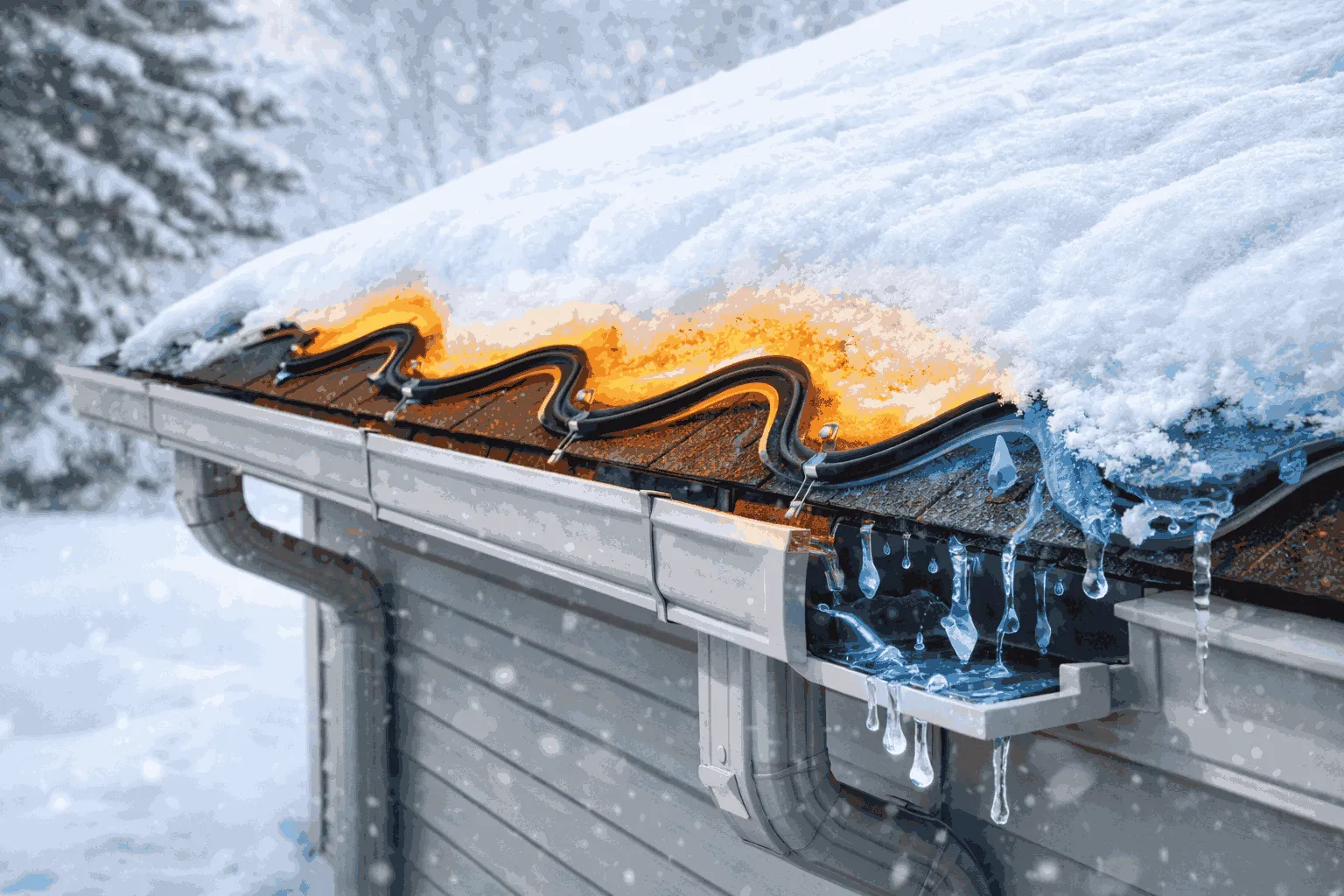
Persistent ice damming on a low-slope roof usually points to heat escaping from below. Improving insulation and air sealing fixes the cause. Chipping ice treats the symptom, every winter, forever.
Which Roof Coating Works on Which Membrane?
A reflective coating can extend service life and cut cooling load, but only if the chemistry matches your membrane and your drainage. The single most common coating failure is an acrylic applied to a roof that ponds.
| Coating | Best suited to | Ponding tolerance | Key caution |
|---|---|---|---|
| Acrylic | Mod-bit, BUR, metal, primed single-ply | Poor. The water-based film re-emulsifies under standing water | Needs a warm, dry cure window. Not for roofs that hold water, and ponding is often excluded from the warranty |
| Silicone | Most substrates with the correct primer | Excellent | Holds dirt and gets slippery when wet. Once cured, recoating generally means more silicone unless the surface is abraded or a tie-coat primer is used |
| Polyurethane | High-traffic areas, SPF roofs, hail-prone regions | Good | Usually a two-coat system, with stronger odor and more VOC handling |
| Asphalt emulsion / aluminized | BUR and modified bitumen only | Poor | Will damage EPDM, TPO and PVC on contact |
Three rules apply regardless of product. The roof must be clean and fully dry before coating. Wet insulation has to be replaced first, because a coating seals moisture in. And get written confirmation that the coating won’t void an active manufacturer warranty before anyone opens a pail.
What Should You Handle Yourself, and What Needs a Pro?
| Reasonable DIY | Call a professional |
|---|---|
| Clearing debris, drains, strainers and gutters | Any seam, flashing or drain-assembly repair |
| Documented visual inspections and photos | Wet or spongy insulation, or a soft deck |
| Gentle removal of light moss with a membrane-safe cleaner | Repeat ponding, sagging, or slope correction |
| Trimming overhanging branches | Punctures larger than a coin, or anything under warranty |
| Ground-level snow raking | Heavy snow loads, ice damming, structural warning signs |
Book one professional inspection a year on top of your own two. Contractors carry moisture meters, know the failure patterns specific to your membrane, and their written report is often the document that keeps a warranty alive.
Seven Mistakes That Shorten a Flat Roof’s Life
- Reaching for a tub of roof cement. Asphalt-based products attack EPDM and are incompatible with TPO and PVC. Patches have to match the membrane.
- Pressure washing. It strips granules from mod-bit, displaces BUR gravel, and can drive water into seams.
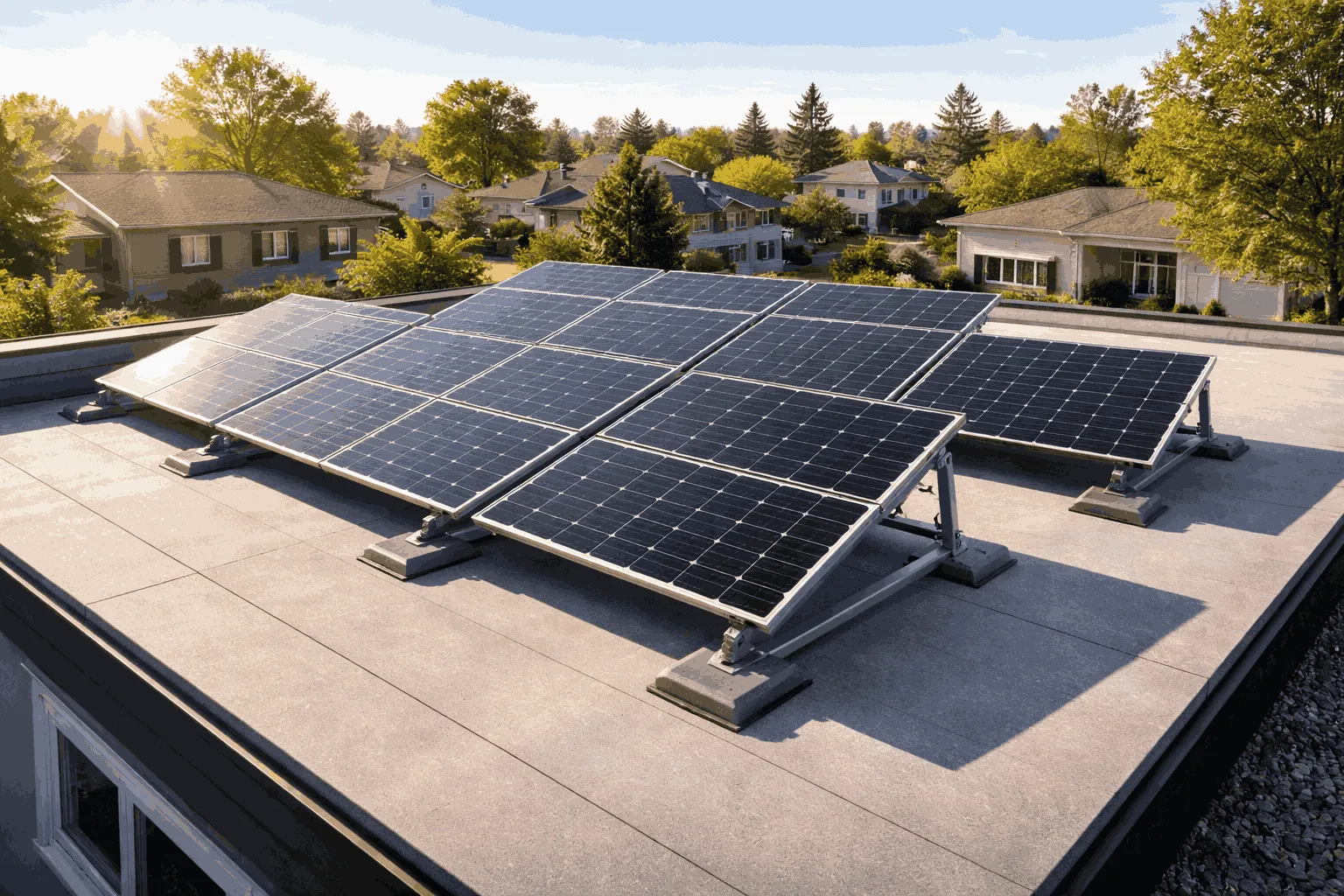
- Letting other trades roam free. Solar, satellite and HVAC installers cause a lot of avoidable punctures. Write walk pads and a post-work roof inspection into every contract.
- Ignoring the overflow. A clean primary drain with a blocked scupper is still an unprotected roof.
- Coating over trapped moisture. This hides the problem and rots the deck underneath it.
- Letting vegetation root. Moss and seedlings hold water and their roots find seams. Remove growth early, and check with your membrane manufacturer before using any cleaner stronger than water and a soft brush.
- No paperwork. Undocumented maintenance is, from a warranty administrator’s point of view, no maintenance.
What Should Be in Your Roof File?
One folder, digital is fine, containing:
- Original installation invoice, membrane type, thickness and manufacturer
- Warranty certificate and its stated maintenance obligations
- Every inspection report, dated, with photos from repeat vantage points
- Every repair: date, location, product used, who did it
- A log of anyone who accessed the roof and why
That file does three jobs. It supports warranty claims, it shows a buyer or insurer that the roof was cared for, and it lets a contractor diagnose a recurring problem in one visit instead of three.
Repair or Replace: How Do You Tell?
Maintenance stops being the answer once the substrate is compromised. Lean toward replacement when:
- A moisture survey shows a significant share of the insulation is saturated. Patching over wet insulation just relocates the leak
- The deck feels soft, or you can see deflection that wasn’t there before
- Leaks appear in new locations each season rather than recurring in one place
- The membrane is at or past its expected service life and the field is widely crazed, shrunken or brittle
- Annual repair spending is climbing toward a meaningful fraction of replacement cost
Replacement pricing varies so much by membrane, insulation, tear-off, deck condition, roof access and local labor market that any national per-square-foot figure is close to useless for budgeting. Get two or three local quotes written against the same scope and compare those instead. What doesn’t vary is the arithmetic on the other side of the ledger: a cleared drain and a twice-yearly walk cost almost nothing next to a tear-off, which is why they’re the highest-return tasks a property owner has.
Frequently Asked Questions
How often should a flat roof be inspected?
Twice a year as a baseline, spring and fall, plus after hail, high wind, or any work performed on the roof. Make one of those visits a licensed contractor’s, since many warranties require documented professional inspection.
Is standing water on a flat roof normal?
Briefly, yes. Water still sitting there 48 hours after rain, in conditions where it should have dried, is not. That’s the National Roofing Contractors Association’s criterion for ponding and a sign of a drainage or slope defect.
Can I walk on my flat roof?
Occasionally and carefully. Use walk pads where they exist, avoid very hot or freezing days, wear soft-soled shoes, and never step on a wet membrane near an edge. Repeated traffic along the same path compresses insulation and creates the low spots that pond later.
Why is my leak nowhere near the damage on the roof?
Because water travels laterally between the membrane, insulation and deck before finding a fastener or joint to drop through. An interior stain shows you the exit, not the entry. A moisture scan is usually faster and cheaper than exploratory cutting.
Do reflective coatings actually save money?
On a dark membrane in a cooling-dominated climate, yes. A lower surface temperature reduces both cooling load and thermal stress on seams. On a roof that already has a white membrane, or in a heating-dominated climate, the energy case is much weaker and the real value is in waterproofing and UV protection. Actual savings depend on your insulation levels, energy prices and roof area, so treat any headline percentage with suspicion.
Will regular maintenance keep my warranty valid?
It’s usually a condition of it. Manufacturer warranties commonly exclude damage from neglect, ponding, unauthorized repairs and incompatible products, and many require periodic inspection with records kept. Read your specific certificate, because the obligations vary more than people expect.
The Bottom Line
Flat roof maintenance isn’t complicated, but it is specific. Know your membrane. Keep water moving off the roof inside 48 hours. Watch the seams, flashings and penetrations rather than the middle of the field. Control who goes up there and what they carry. Write it all down. Those habits cost a few hours a year, and they’re most of the difference between a roof that reaches its expected service life and one that fails early. They also turn what would have been an emergency call into a scheduled, predictable repair.